

Calculating the Breakeven Point in Sports Betting

Published on: September 8, 2022

Updated on: August 19, 2026

Category: Advice & Tips
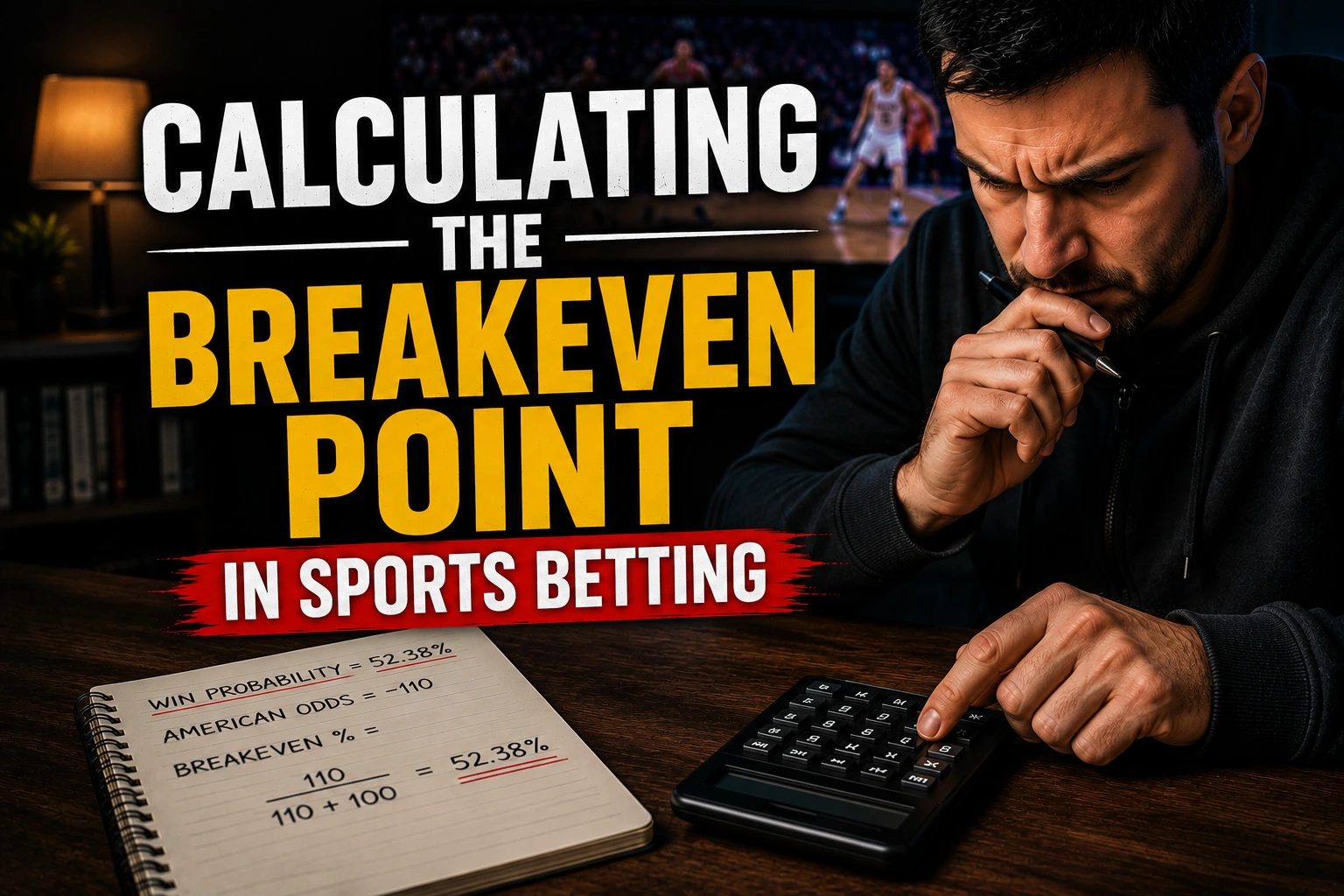
Calculating the breakeven point in sports betting with a bettor using a calculator and notebook showing the 52.38% breakeven rate for -110 odds.

The following post explores calculating the breakeven point in sports betting.

Looking to achieve profitability? Understanding your breakeven point gives you a clear understanding of how much you need to win to cover your losses and start making money.

Read: Pitfalls of Buying Sports Betting Picks

Related: Avoiding the Gambler’s Fallacy in Sports Betting

Breakeven provides a framework for evaluating the effectiveness of your betting strategy, managing expectations, and staying disciplined in the face of losses or streaks of bad luck.

Here’s what you need to know.

Overview

So, what is the breakeven point? Basically, it’s the winning percentage needed to balance losses and gains, factoring in the standard juice applied by sportsbooks – typically set at -110. To determine your breakeven point, you need to understand the relationship between the odds you’re betting at and your required win rate.

Understanding Juice

Essentially, the juice represents the price of placing a bet. When odds are -110, a bettor must risk $110 to win $100. The additional $10 represents what the sportsbook receives for taking your action.

Documenting Your Wagers

Keeping detailed records of your wagers is key for calculating your breakeven point. Tracking the odds you paid week-over-week is the requisite data for understanding your cumulative breakeven point.

Calculating Breakeven

To calculate your breakeven point, consider the following formula:

  • Breakeven Percentage = Risk ÷ Total Payout x 100

In the case of -110 odds, where the risk is $110 and the total payout (including the initial stake and profit) is $210, the breakeven percentage is:

  • Breakeven Percentage = 110 ÷ 210 × 100 ≈ 52.38%

This means that, to break even in the long run, a bettor needs to have a winning percentage exceeding 52.38%. Anything below this threshold would result in an overall loss due to the vig.

Breakeven Percentage Changes With the Odds

The 52.38% breakeven point applies specifically to -110 odds. The percentage changes depending on the price of the wager. When a bettor pays more juice, the required winning percentage increases. When a bettor receives plus-money odds, the required winning percentage decreases.

For example, the breakeven percentages for several common betting prices are:

  • -105 odds: 51.22%

  • -110 odds: 52.38%

  • -115 odds: 53.49%

  • -120 odds: 54.55%

  • +100 odds: 50.00%

  • +150 odds: 40.00%

This is one reason shopping for the best available odds can be important. A bettor who consistently finds -105 instead of -110 needs to win at a lower percentage to break even. Small differences in the price can become meaningful over a large number of wagers.

Breakeven vs. Profitability

Reaching the breakeven percentage does not necessarily mean a bettor is profitable. It means the bettor has reached the approximate win rate needed to cover the cost of the juice. To generate a long-term profit, the bettor needs to win at a rate above the breakeven point at the prices being paid.

For example, a bettor winning 52.38% of -110 wagers is approximately at the breakeven point. A bettor winning 55% of those wagers has moved beyond breakeven and is generating a positive expected return, assuming the same odds are consistently available.

The difference may seem small, but over hundreds or thousands of wagers, even a few percentage points above breakeven can have a meaningful impact on results.

Example: Breakeven Over Multiple Bets

Consider a bettor who places 100 wagers at -110 odds and risks $110 on every bet. If the bettor wins 53 of those wagers and loses 47, the 53 wins generate $5,300 in profit. The 47 losses cost $5,170, producing a net profit of $130.

Now consider the same bettor winning 52 wagers and losing 48. The 52 wins generate $5,200 in profit, while the 48 losses cost $5,280. The bettor would finish the 100 wagers with an $80 loss.

These examples demonstrate why the 52.38% breakeven point matters. A one-win difference over 100 wagers can move the bettor from a loss to a profit, even though both results are close to the same overall winning percentage.

Why Tracking Your Actual Betting Odds Matters

Your personal breakeven point depends on the prices you actually receive, not simply the prices you assume you’re betting. A bettor who consistently wagers at -110 has a different breakeven point than a bettor who frequently lays -115 or -120.

This makes accurate record-keeping particularly important. By tracking the odds, wager amount, outcome, and profit or loss for every bet, you can determine whether your actual win rate is high enough to overcome the prices you’re paying.

Over time, this information can provide a much clearer picture of whether a betting strategy is genuinely profitable or simply producing results that appear successful because of a short-term winning streak.

Leave A Comment