

Lessons from ‘Trading Bases’ by Joe Peta
Published on: April 8, 2025
Updated on: April 11, 2025
Category: Advice & Tips
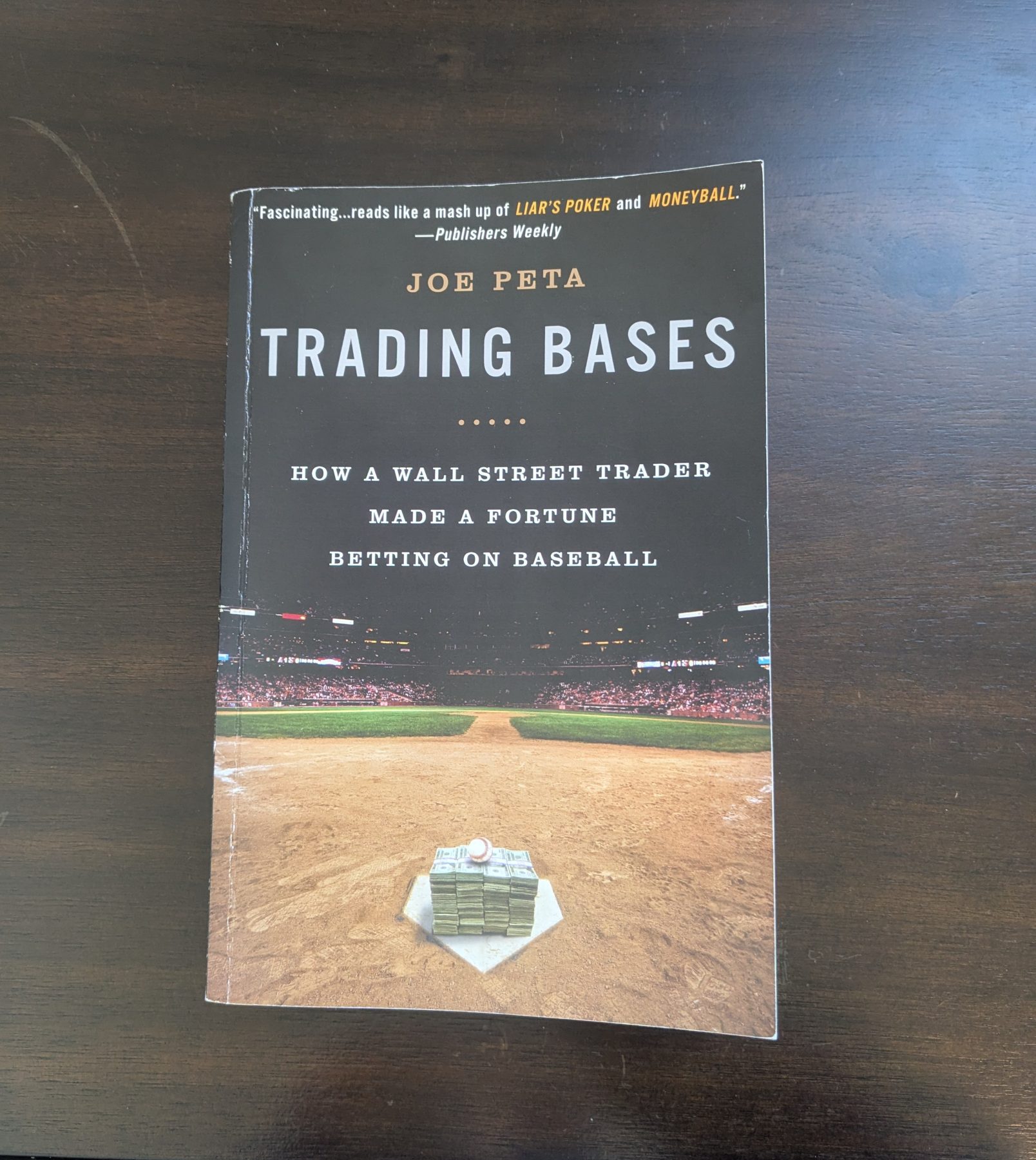
The following post explores Lessons from ‘Trading Bases’ by Joe Peta.
Published in 2013, ‘Trading Bases’ is a 384-page book with 25 chapters that documents his experience and approach of applying financial and analytical methods to betting on baseball.
Read: Lessons from ‘Gambler: Secrets From a Life at Risk’ by Billy Walters
Related: Lessons from ‘Betting the Bases’ by Mike Lee
In this book, Joe Peta explores how financial market strategies – such as stock trading techniques and investment models – can be used for betting on MLB.
Here’s what you need to know.
About the Author
Joe Peta is an author, analyst, and sports bettor with over a decade of experience working on Wall Street at firms like Bear Stearns and Deutsche Bank.
In the book, Peta shares his personal story of getting hit by an ambulance, ending up bedridden, and deciding to use his downtime to build a baseball betting model similar to how hedge funds use models to trade stocks.
His book has a 4.2/5 rating on 344 reviews on Amazon.
Part One: The Model (Chapters 1-6)
In part one of Trading Bases, Peta lays the foundation of the book. He introduces readers to the central idea: that the same quantitative techniques used in Wall Street investing can be applied to baseball betting.
Chapter 1: The Accident and the Awakening
Joe Peta recounts the accident that left him in a wheelchair and led to his dismissal from Wall Street. During his recovery, he rekindles his passion for baseball and considers applying his financial expertise to sports betting.
Chapter 2: Wall Street Meets Baseball
Drawing parallels between financial markets and baseball, Peta introduces the idea of treating baseball teams like stocks. He discusses the concept of market inefficiencies and how they can be exploited in both arenas.
Chapter 3: The Birth of a Betting Model
Peta delves into the development of his proprietary baseball betting model. He explains how he uses sabermetrics and statistical analysis to predict game outcomes.
Chapter 4: Understanding Sabermetrics
This chapter provides a primer on sabermetrics, the empirical analysis of baseball statistics. Peta discusses key metrics like WAR (Wins Above Replacement) and OPS (On-base Plus Slugging).
Chapter 5: Building the Model
Peta outlines the components of his betting model, including factors like park effects, weather conditions, and player injuries. He emphasizes the need for a comprehensive approach that factors in all the relevant variables.
Chapter 6: Testing the Model
Peta shares his experiences testing the model during the 2011 baseball season. He discusses the challenges of real-world application, including the psychological aspects of betting and the importance of discipline.
Part Two: The Launch (Chapters 7-18)
In part two, now that the model is built, this section shows what happens when Peta actually puts it to work. It’s the real-world application phase of the book.
Chapter 7: The Importance of Bankroll Management
Peta stresses the significance of proper bankroll management in sports betting. He draws comparisons to risk management in finance (highlighting prudent bet sizing and emotional control).
Chapter 8: The Role of Luck and Variance
This chapter explores the concepts of luck and variance in both investing and sports betting. Peta discusses how to differentiate between skill and chance, and how to adjust strategies accordingly.
Chapter 9: Evaluating Team Performance
Peta examines how to assess team performance beyond win-loss records. He introduces advanced metrics and discusses how to identify undervalued teams that present profitable betting opportunities.

Pictured: image of Peta’s model projects (Chapter 9).
Chapter 10: The Betting Season
Peta recounts his experiences throughout the betting season, sharing insights into the day-to-day operations of a professional sports bettor. He discusses the emotional highs and lows and the lessons learned along the way.
Chapter 11: Lessons from Wall Street
Peta reflects on the lessons he brought from Wall Street to sports betting, including the importance of data-driven decision-making, risk assessment, and continuous learning.
Chapter 12: Conclusion and Future Outlook
Peta reflects on the culmination of his analytical efforts and prepares to implement his strategies in real-time betting scenarios. He emphasizes the importance of discipline, risk management, and adherence to the model’s insights.
Chapter 13: The Daily Grind
Peta delves into the routine of daily betting, emphasizing the importance of discipline and consistency. He discusses how he manages his time, analyzes games, and places bets.
Chapter 14: The Psychology of Betting
This chapter explores the psychological aspects of sports betting. Peta discusses common cognitive biases, such as overconfidence and recency bias, and how they can affect decision-making.
Chapter 15: The Role of Luck
Peta examines the role of luck in both investing and sports betting. He discusses how to differentiate between skill and chance, and the importance of understanding variance.
Chapter 16: Adjusting the Model
In this chapter, Peta discusses the need to continually refine his betting model. He talks about incorporating new data, responding to changes in the baseball landscape, and learning from both successes and failures.
Chapter 17: The Business of Betting
Peta provides insights into the business side of sports betting. He discusses the logistics of placing bets, dealing with sportsbooks, and managing bankrolls. He also touches on the challenges of scaling betting operations.
Chapter 18: Comparing Markets
Drawing parallels between financial markets and sports betting markets, Peta analyzes their similarities and differences. He discusses concepts like market efficiency, liquidity, and information asymmetry.
Part Three: Success (Chapters 19-25)
In part three, the final stretch, Peta reflects on the outcome of his betting season, and what he learned about sports betting, finance, and himself.
Chapter 19: The Human Element
Peta emphasizes the importance of the human element in both baseball and betting. He discusses how player psychology, team dynamics, and managerial decisions can impact game outcomes.
Chapter 20: Risk Management
This chapter focuses on risk management strategies. Peta discusses techniques for mitigating risk, such as diversification and position sizing, and how these concepts from finance apply to sports betting.
Chapter 21: The Season’s End
Peta reflects on the conclusion of the baseball season, analyzing the performance of his betting model. He discusses the outcomes, lessons learned, and areas for improvement, providing a candid assessment of his approach.
Chapter 22: Beyond Baseball
Exploring the applicability of his model to other sports, Peta discusses the potential for using similar analytical approaches in different contexts. He considers the challenges and opportunities of expanding beyond baseball.
Chapter 23: The Future of Sports Betting
Peta offers his perspective on the future of sports betting, considering technological advancements, regulatory changes, and the increasing role of analytics.
Chapter 24: Personal Reflections
Peta shares personal reflections on his journey from Wall Street to sports betting. He discusses the impact of this transition on his life, the fulfillment he finds in his new career, and the lessons he’s learned.
Chapter 25: Final Thoughts
Peta concludes the book by summarizing key takeaways and offering advice to aspiring sports bettors. He emphasizes the importance of discipline, continuous learning, and maintaining a data-driven approach.
Key Lessons
Here are some of the key lessons from Trading Bases — insights that go beyond baseball and betting, and speak to the value of discipline, data, and decision-making over time.
Betting is Investing – If You Treat it That Way
The central theme of Trading Bases is that sports betting, particularly in baseball, can be approached like a financial market. With the right data, discipline, and risk management, bettors can identify inefficiencies and make profitable decisions—just like investors on Wall Street.
Lesson: View bets as investments, not gambles. Every wager should have an expected value and be part of a larger, long-term strategy.
Models Beat Gut Instincts
Peta uses sabermetrics and advanced statistical modeling to build a predictive framework that outperforms the market. Unlike “gut-feeling” gamblers, he relies on data-driven analysis, and over time, this gives him a sustainable edge.
Lesson: Develop and trust your model. Avoid emotional betting. Let probabilities guide your decisions (not emotions).
Discipline and Bankroll Management Are Non-Negotiable
Even with a working model, Peta emphasizes how critical it is to stick to strict bankroll rules. The ups and downs of variance are inevitable, and chasing losses or betting too big can wipe out even the best strategies.
Lesson: Long-term success requires consistent stake sizing, avoiding tilt, and protecting your bankroll.
Market Inefficiencies Exist – But They’re Narrow
Just like on Wall Street, inefficiencies in betting markets are rare and fleeting. Peta finds value in smaller edges and exploits them across hundreds of games over a season.
Lesson: Don’t look for massive edges. Focus on small, repeatable advantages and scale them with volume and patience.
Recordkeeping and Analysis Are Vital
Peta tracks every wager, logs outcomes, and constantly refines his model. He treats his betting operation like a business (because it is one).
Lesson: Maintain a detailed record of bets, outcomes, and rationale. Use this data to learn, improve, and avoid repeating mistakes.
Success Comes from Process, Not Prediction
Peta emphasizes process over results. Even well-placed bets can lose, and even bad bets can win. What matters is making smart decisions over and over, trusting the law of large numbers to deliver profits.
Lesson: Judge your decisions by the quality of the process (not the outcome of individual bets).
Analytics Can Democratize Expertise
Trading Bases shows how a regular person with statistical tools can outperform “experts,” whether they’re Vegas oddsmakers or Wall Street pros. it’s a call to action for data-literate bettors to stop betting blindly.
Lesson: You don’t need insider info to win – you need a model, access to data, and the discipline to use them well.