
How to Bet Football
Published on: July 31, 2021
Updated on: February 21, 2025
Category: Advice & Tips

The following post explores the basic fundamentals of how to bet football.
Whether you’re wagering on the NFL or NCAAF, understanding how to interpret odds, spreads, and different bet types is essential for making football wagers.
Read: Flat Betting For Wagering Success
Related: How to Use Parlay Cards at the Sportsbook
This post provides a high-level overview of football betting, covering key concepts such as point spreads, money lines, totals, and additional wager types to help you get started.
Here’s what you need to know.
Example
Here is an example of a football wager, let’s break it down.
| Time | Bet # | Team | Spread | Total | Money Line |
| 1:00 PM | 106 | Chicago Bears | +3 -110 | o44 | +150 |
| 107 | Green Bay Packers | -3 -110 | u44 | -140 |
-
Away team is always listed on top. In this example, the Chicago Bears are the road team.
-
Minus (-) next to the number in the money line indicates the favorite; the plus (+) indicates the underdog.
-
Bet # is most commonly referred to when verbally placing your wager at the sportsbook.
Wager Types
-
Spread – When betting the point spread (aka line), the favorite must win by a stipulated number of points. This means either laying points on the favorite or getting points on the underdog. In this example, Green Bay (-3 -110) is the favorite and must win the game by more than 3 points to cover the spread.
-
Total – This refers to the total number of combined points scored (i.e. over/under). If the game lands exactly on the set number, the wager is considered a push and those bets are refunded.
-
Money Line – This is a bet on which team will win a game (regardless of score). Chicago is a +150 money line underdog on the road. This means a $100 wager on Chicago money line wins $150 (collect $250 total). Conversely, a $140 wager on the Packers money line wins $100 (collect $240 total).
Additional Wagers
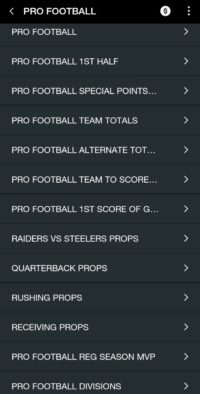
Screenshot: Football Wager Options on a Mobile App
-
1st Half – This refers to the outcome of the game at halftime. In this example, the likely first half line is set to Green Bay -1.5 (point spread) and -120 (money line).
-
Half Time – A half time line refers to the second half outcome of a game. For instance, if the Bears lead the Packers 14-10 at halftime, oddsmakers set a 2nd half line of Packers -6.5. This means the Packers must outscore the Bears by seven or more points in the 2nd half to cover the half time spread.
-
Futures – Futures wagers in football are for predicting division winners, conference winners, and Super Bowl winners. Total games won (O/U wins) is another popular futures wager offered at the beginning of the season.
-
Live – Live wagering is a popular option for making in-game bets using your sportsbook’s mobile application (check availability). Live wagers offer adjusted point spreads, over/under, point totals, and more based on the game’s score.
-
Parlay – A parlay combines several teams into one bet. In a parlay, all wagers must win, or else the bet is a loser. As many as 10 teams (or more) may be used in a parlay. Totals (O/U points) may be included in parlays. In the event of a rain-out, cancellation, or tie, the parlay is reduced to the next lowest number of games. For example, a four team parlay becomes a three team parlay in such an event.
-
Props – A “proposition bet” is like a side-bet. Common prop bets in football include passing (yards thrown), rushing (yards running), and defense (sacks, interceptions). Prop bets offered vary greatly from sportsbook to sportsbook.
-
Teasers – Many sportsbooks offer 6, 6.5, 7, 10, and 14-point teasers in football. This allows you to add extra points to the point spread on an underdog or subtract points on a favorite. Teasers are more expensive than parlays due to their significantly adjusted point spreads.